HNMCP@20: Reimagining Dispute Systems for a Changing World

Harvard Negotiation & Mediation Clinical Program (HNMCP)
Harvard Law School, Cambridge, MA
November 6–7, 2026
As the Harvard Negotiation and Mediation Clinical Program marks twenty years of experiential teaching, research, and practice in dispute systems design and conflict engagement, we invite you to join us for a special two-day gathering focused on the future of our field.
At a moment of profound institutional and societal change, what can dispute systems design contribute to building systems that are more resilient, responsive, and just?
“HNMCP@20: Reimagining Dispute Systems for a Changing World” will bring together colleagues, practitioners, students, alumni, scholars, and institutional leaders from across disciplines to explore that question together. Through short presentations, facilitated conversations, small-group work, and collaborative visioning, we will consider how our field can respond to changing conditions and develop priorities and possibilities for future collaboration.
The gathering will build on conversations taking place in four HNMCP practice areas: court-connected systems, organizational systems, peacebuilding systems, and community systems. Our goal is not simply to look back on twenty years of work, but to help shape what comes next.
We hope you will join us in Cambridge for this generative and interactive conversation about the future of dispute systems design and conflict engagement.
What to Expect
“HNMCP@20” will be an interactive, forward-looking gathering designed to help us imagine and begin shaping the next chapter of dispute systems design and conflict engagement.
The program will move from reflection and inspiration toward collective development and action:
- We will begin by looking ahead. A facilitated visioning exercise will invite participants to consider the conditions our field—and the communities, organizations, and institutions we serve—may face in the years ahead. What will dispute systems design and conflict engagement require in that future? What might we need to learn, rethink, or build?
- We will hear from people engaged in promising work. Brief lightning-round presentations will offer examples, experiments, and provocations from practitioners, scholars, students, alumni, and institutional leaders working across disciplines and contexts.
- We will develop four central themes together. Cross-disciplinary conversations will invite participants to explore and deepen the four themes that have emerged through HNMCP’s preparatory working-group process. The cross-disciplinary conversations will focus on:
- how to build trust, legitimacy, and meaningful participation when established systems are under strain;
- how to address power, voice, and context in increasingly polarized and unequal environments;
- how to balance technological possibility with human judgment, accountability, and access; and
- how to create sustainable infrastructure for conflict prevention and engagement rather than relying solely on episodic responses to conflict.
- We will move from ideas toward priorities. Through facilitated small-group dialogue and collaborative brainstorming, participants will identify promising directions, areas requiring further experimentation or research, and opportunities for future collaboration.
- We will identify ways to continue the work. The gathering will conclude by considering how these themes and priorities might lead to ongoing conversations, public-facing resources, research or teaching initiatives, or other forms of collective work.
An evening dinner and celebration will offer an opportunity to reconnect with HNMCP colleagues, meet new collaborators, and mark twenty years of teaching, research, and practice.
You do not need to arrive with particular expertise. The most valuable contribution is your experience, curiosity, and willingness to think with others about what comes next.
Working Groups
In preparation for “HNMCP@20,” colleagues gathered in four working groups during August and September to explore the challenges, opportunities, and innovations that may define the next generation of dispute systems design and conflict engagement.
Each group met twice to reflect on emerging needs, share experiences and promising practices, and identify questions that merit further attention. The groups’ discussions are helping to shape the themes and conversations for the November gathering and may also inform future HNMCP initiatives.
The four working groups reflected HNMCP’s core areas of practice:
Court-Connected Systems
How can courts continue to advance substantive and procedural justice through effective dispute systems design and ADR?
Organizational Systems
How can mission-driven organizations design and refine conflict resolution systems to strengthen their effectiveness?
Peacebuilding Systems
How can organizations and coalitions build and navigate participatory systems that support sustainable peace?
Community Systems
How can groups work collectively to strengthen connection and advance social and economic justice within their communities?
Across the four groups, several cross-cutting themes emerged. These themes will provide a framework for the cross-disciplinary conversations at “HNMCP@20,” where participants will be invited to develop them further and consider their implications for the field.
- Trust, Legitimacy, and Meaningful Participation: At a time when confidence in public institutions, organizations, and established processes is increasingly fragile, how can dispute-resolution systems become more trustworthy and legitimate? What does meaningful participation require when people feel unheard, excluded, or skeptical that participation will make a difference?
- Power, Voice, and Context-Sensitive Practice: As conflicts become more polarized and longstanding inequities become harder to ignore, how can conflict engagement practices address power more directly? How can systems make room for voices that have historically been marginalized while remaining attentive to local histories, relationships, cultures, and forms of knowledge?
- Technology, Human Judgment, and Access to Justice:As artificial intelligence and other technologies rapidly reshape how people communicate, make decisions, and access services, what should be automated, and what must remain human? How can technology expand access to conflict engagement without reproducing bias, deepening inequality, weakening accountability, or displacing human judgment and connection?
- Sustainable Infrastructure for Prevention, Repair, and Peace: At a time of intensifying social division, institutional strain, and violent conflict, how can we move beyond responding to crises one dispute at a time? What relationships, capacities, and institutions are needed to prevent harm, support repair, and sustain peace and justice over time?
Program
The gathering will include a full day of programming on Friday, followed by an evening celebration and dinner, and a half day of programming on Saturday.
The program will combine:
- shared visioning exercise focused on the future of the field;
- brief presentations highlighting creative and promising work;
- facilitated small-group conversations;
- opportunities to connect across HNMCP’s practice areas; and
- collaborative brainstorming about future priorities, partnerships, and projects.
Frequently Asked Questions
Is the event interactive?
Yes. “HNMCP@20” is designed as a participatory convening rather than a traditional conference. In addition to brief presentations, participants will take part in facilitated discussions, small-group conversations, visioning, and collaborative idea generation. The goal is for attendees to contribute to shaping the conversation and identifying priorities for future work.
Who should attend?
The gathering is intended for practitioners, scholars, students, alumni, educators, institutional leaders, and others interested in dispute systems design, conflict engagement, ADR, peacebuilding, organizational practice, community justice, and related fields.
Do I need to be a dispute systems design specialist?
No. We welcome people with a range of backgrounds and levels of experience. The event is intended to foster exchange across disciplines and practice areas.
What will the event produce?
The gathering will help identify emerging needs, promising practices, and priorities for the field. Participants will also have opportunities to explore future collaborations and possible follow-up projects, such as additional conversations, a speaker series, written resources, or other forms of collective inquiry.
How are the working groups connected to the event?
The working groups are helping to inform the questions and themes that will shape “HNMCP@20.” Their work will contribute to the broader conversation at the gathering and may also provide a foundation for future projects.
Will the event be available virtually?
Non-interactive portions of the event will be available virtually. We will share recordings after the event.
What is the schedule?
The event will include programming throughout the day on Friday, an evening dinner and celebration, and a half day of programming on Saturday. A detailed agenda will be posted when available.
Whom should I contact with questions?
Please contact [email protected] with questions about registration, accessibility, travel, or participation.
Hotels
The following hotels in Harvard Square and the greater Cambridge area have offered a conference rate. Fall is a busy time of year in Cambridge so please book early.
- Irving House (use promo code “HNMCP26”)
- Porter Square Hotel (Please call the hotel directly for reservations referencing the code “HNMCP2” or “Harvard Negotiations & Mediation Clinical Program.” This code will not work for online bookings. Please call the hotel at 617.499.3399).
- Hotel 1868 (Please call the hotel directly for reservations referencing the code “HNMCP2” or “Harvard Negotiations & Mediation Clinical Program.” This code will not work for online bookings. Please call the hotel at 617.499.2998).
- The Atlas Hotel (Please book at this URL for the promotional code: https://www.theatlashotel.com/book/?promoCode=HRVDA.)
Other Hotels in Harvard Square and Cambridge
- Boston Marriott Cambridge
- The Charles Hotel
- Freepoint Hotel Cambridge (Hilton)
- The Sheraton Commander
Directions
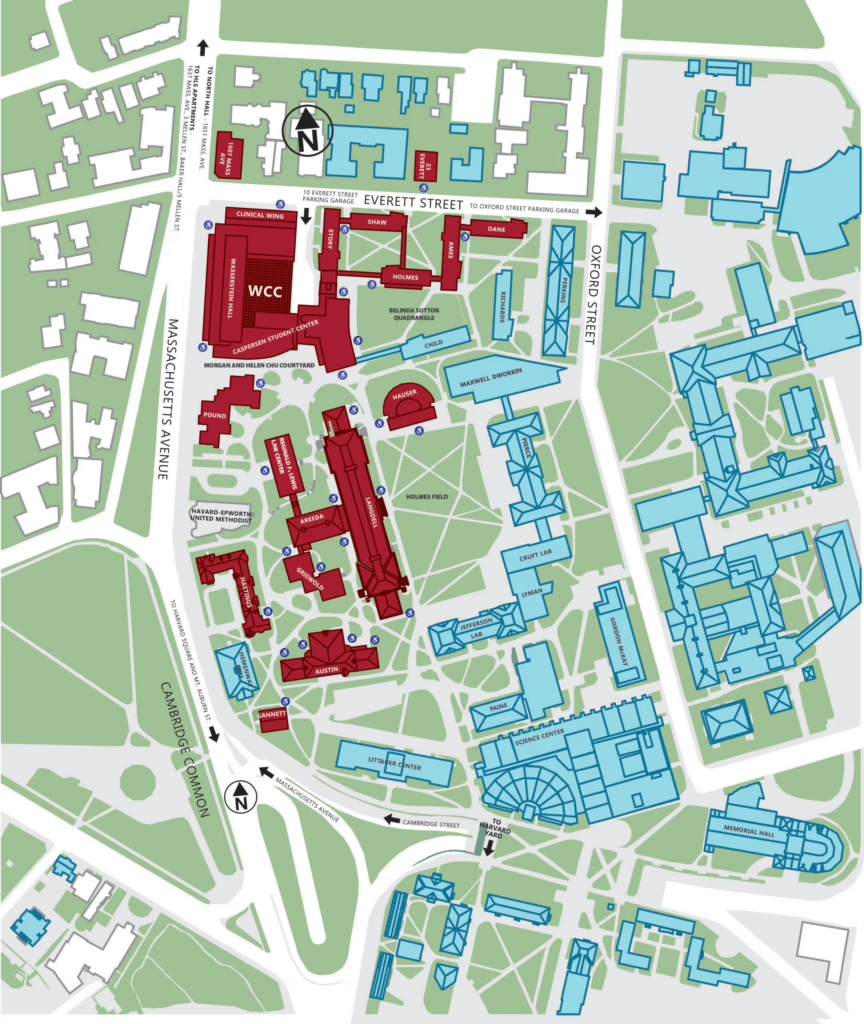
Our 20th anniversary celebration and conference will take place in the the Wasserstein Hall/Caspersen Student Center/Clinical Wing complex (referred to as “WCC” on the map below). If you are traveling by Uber/Lyft/taxi from Logan Airport or the South Station Amtrak station in downtown Boston, you can give your driver the address “1585 Massachusetts Avenue in Cambridge.”
If you are driving, parking information will be added here closer to the date.